
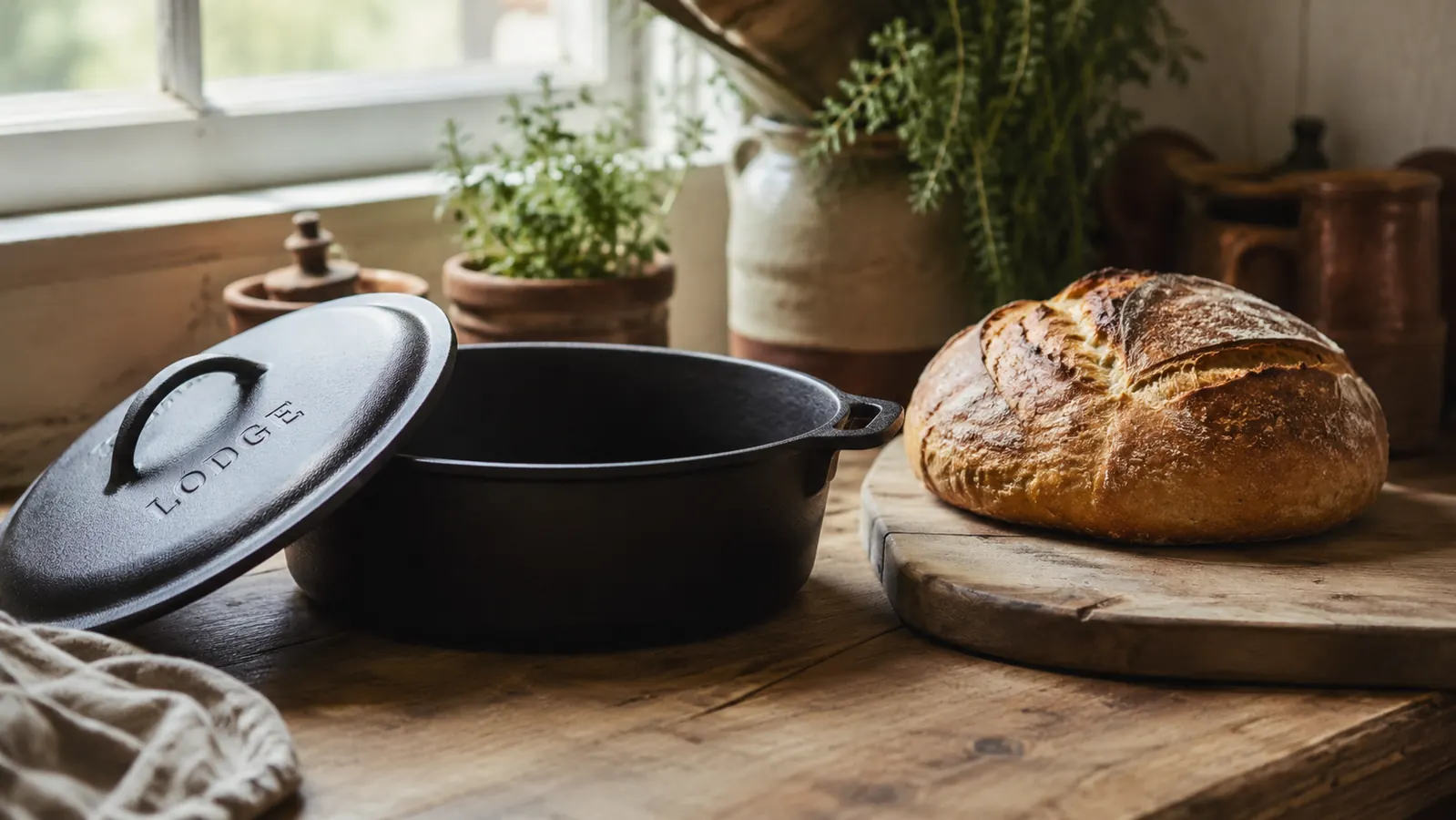
I get this question every few weeks from someone in my baking group: should I buy the Lodge or save up for Le Creuset? My answer has been the same for three years of baking bread in both. The Lodge Cast Iron Double Dutch Oven 5qt does everything a bread baker needs, at a price that leaves you money for flour, a good banneton, and maybe a bench knife you will actually use. If you are chasing a dark, blistered crust and a wide-open ear on your sourdough, the pot matters far less than your fermentation timing and your preheat. But I know that answer feels too simple, so let me actually walk you through the real differences.
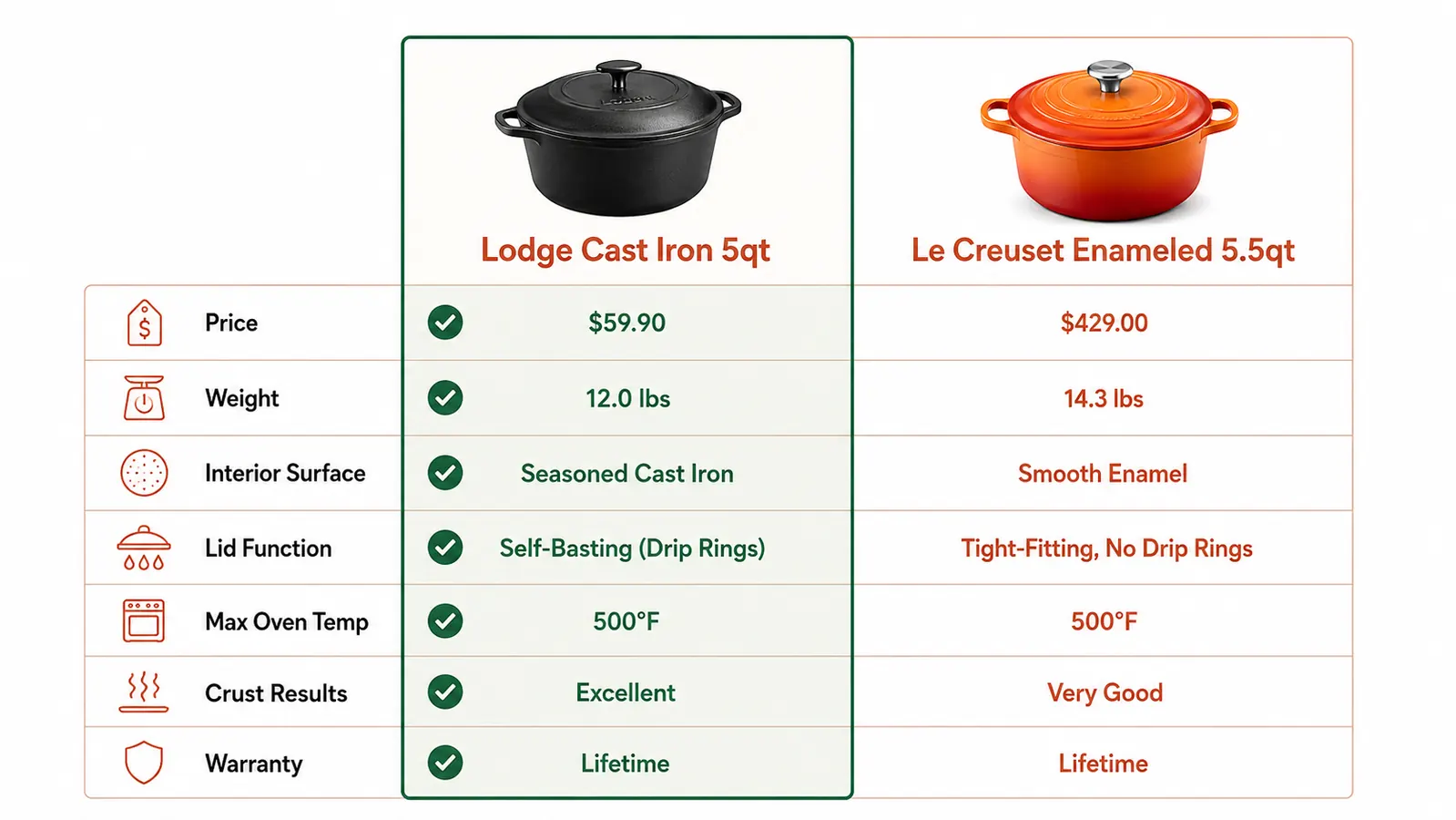
I have baked well over 200 loaves in the Lodge, and I borrowed a friend's 5.5qt Le Creuset round Dutch oven for four months to bake directly alongside it, using the same starter, the same flour, the same fridge. The results were close enough that I gave the Le Creuset back without any regret. Here is the full side-by-side so you can decide for yourself.
| Lodge Dutch Oven | Le Creuset for Bread Baking | |
|---|---|---|
| Price (current) | Check today's price on Amazon | Premium price range |
| Weight | 12 lbs | 13.5 lbs |
| Interior surface | Pre-seasoned raw cast iron | Light-colored enamel coating |
| Lid function | Flat lid doubles as a 10-inch skillet | Domed lid, single use only |
| Max oven temp | 500 degrees F (no limit with lid off) | 500 degrees F (manufacturer limit) |
| Crust development | Excellent, very dark crust achievable | Excellent, nearly identical results |
| Warranty | Lifetime limited | Lifetime limited |
| Handles when hot | Small loop handles, need full mitts | Larger helper handles, easier grip |
| Cleanup | Hand wash only, re-oil occasionally | Hand wash recommended, easier stain release |
You do not need to spend $380 to bake bread this good.
The Lodge 5qt Double Dutch Oven has over 15,000 ratings averaging 4.7 stars. Bread bakers consistently call it the best money they ever spent in their kitchen.
Amazon Check Today's Price on Amazon →What a Dutch Oven Is Actually Doing for Your Bread
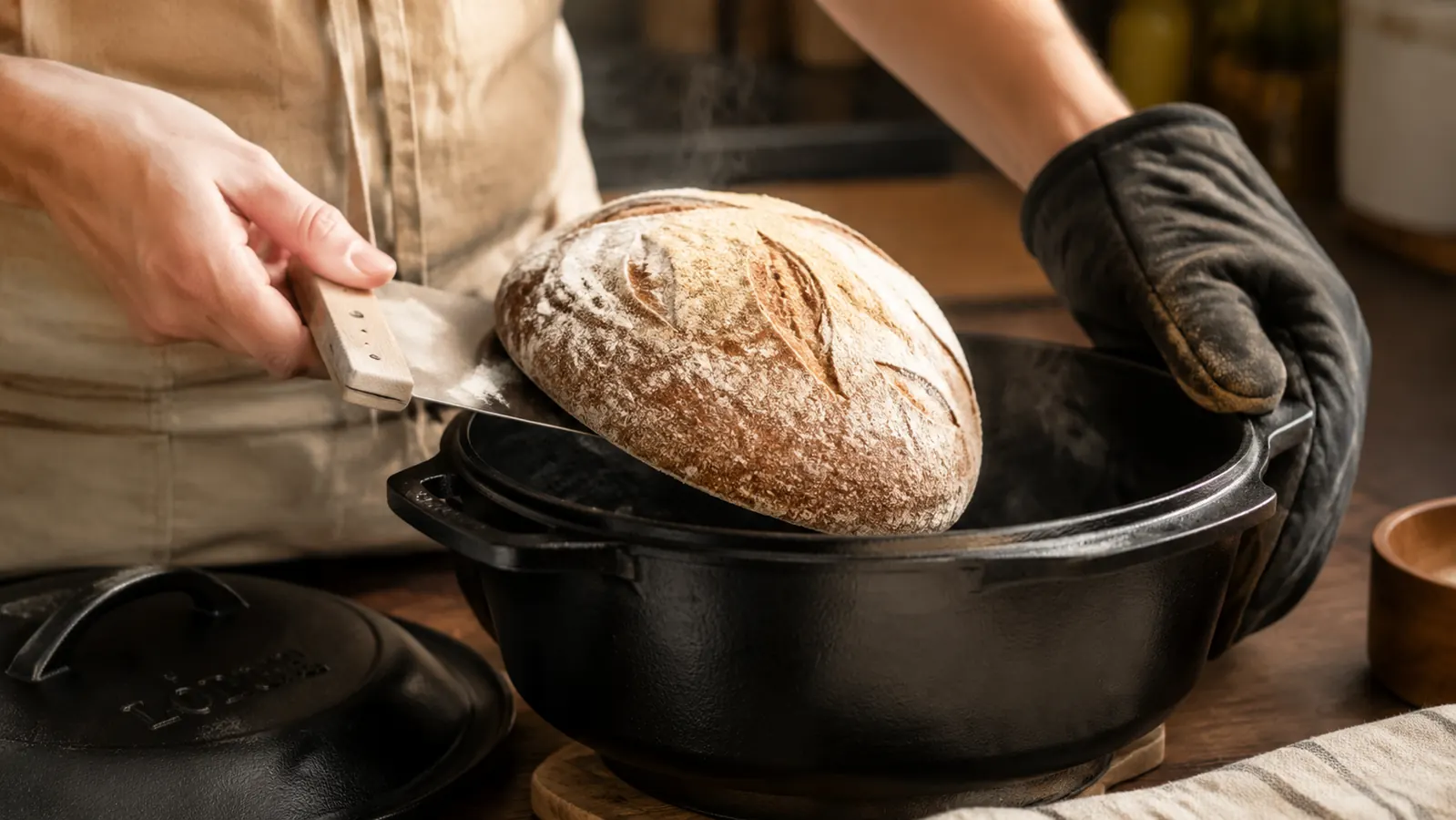
Before you can evaluate which pot to buy, you need to understand what the Dutch oven is actually doing for your loaf. When you load your scored dough into a screaming-hot pot and clap the lid on, you trap the steam that releases from the dough itself during the first 20 minutes of baking. That steam keeps the crust pliable long enough for the loaf to expand fully before the crust sets hard. Without trapped steam, the crust skins over too fast and you get a dense, low-profile loaf with no ear and no blisters. Every professional bakery has a deck oven that injects steam at the start of the bake. Your Dutch oven replicates that for about the cost of a decent bottle of wine.
The second thing a Dutch oven contributes is thermal mass. Cast iron stores and radiates heat like almost nothing else you can put in a home oven. When cold dough hits the bottom of a preheated pot, it gets a concentrated blast of bottom heat that drives oven spring fast, before the crumb structure has a chance to firm up and resist expansion. That bottom heat is what pushes a loaf tall instead of wide. Both Lodge and Le Creuset are cast iron. Both deliver that bottom heat. The physics are identical. This is the central reason the bake results between these two pots look so similar in practice.
Where the Lodge Wins for Bread Bakers
The Lodge has three real advantages over Le Creuset for dedicated bread bakers. The first is the lid design. The Lodge Double Dutch Oven ships with a flat lid that is also a fully functional 10-inch skillet. This is not marketing copy. I use that lid to sear pork chops, make skillet cornbread, and fry eggs at least twice a week. You are getting two genuinely useful pieces of cookware for the price of one inexpensive pot. The Le Creuset's domed lid sits on the pot and does nothing else. If bread baking is your primary use, the Lodge lid is more functional by a wide margin.
Second, the raw cast iron interior means you can push oven temperature as high as your oven goes without a second thought. I preheat my Lodge at 500 degrees F for a full 45 minutes before loading dough. I have done this hundreds of times. The enameled interior of a Le Creuset is generally safe to the same temperature, but the enamel can develop hairline crazing over time if you subject it to repeated extreme thermal shocks, particularly if the pot has any moisture on the exterior when it goes in cold. The Lodge has no coating to develop hairlines. You season a chip and keep baking. Third, if you drop the Lodge or crack the rim after three years of hard use, you are not grieving a $400 purchase. You season it and move on. That psychological ease is worth something to the kind of baker who bakes bread every single week.
The steam your dough releases in the first 20 minutes does nearly all of the work. The pot just has to trap it reliably. Both of these pots do that perfectly.
Where Le Creuset Wins
I want to be fair here because this comparison is only useful if it is honest. Le Creuset wins clearly on ergonomics. The helper handles on the Le Creuset are significantly more comfortable to grip with thick oven mitts on, which matters meaningfully when you are lifting a 13-pound pot from a 500-degree oven and trying to set it down on your stovetop without wobbling. The Lodge loop handles require a deliberate, confident grip. Neither is dangerous if you have proper mitts, but the Le Creuset is more forgiving of imprecise hand placement. If you have any hand strength issues or bake with early mornings and half-awake hands, the Le Creuset ergonomics are genuinely better.
The light enamel interior is also a real advantage when baking breads with inclusions like seeds, olives, or dried fruit. You can see what is sticking more easily and address it before it bakes on permanently. And the enamel releases dough residue more cleanly than raw iron after a bake where the scoring opened unexpectedly and dough spilled onto the pot wall. Lodge cleanup is not hard, but it does require a chain scrubber or a stiff brush and a light re-oiling after each wash. That is a two-minute task, but it is a task the Le Creuset does not require. Neither of these things changes what the bread tastes like. But they do affect your daily experience of using the pan, and that matters when something lives on your stovetop.
Crust, Ear, and Oven Spring: The Side-by-Side Results
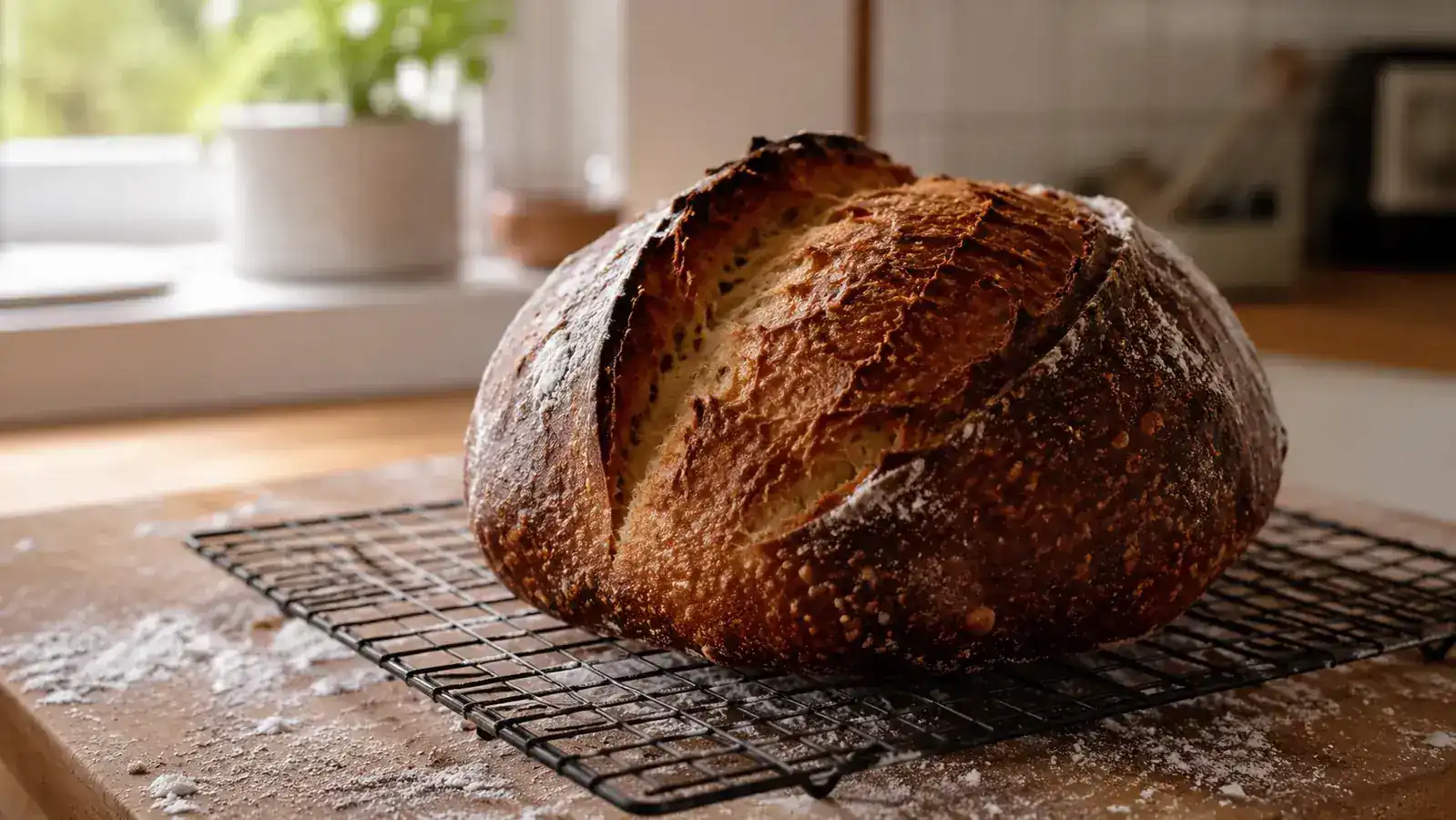
This is what people actually want to know. I baked the same sourdough formula in both pots during the same week, with the same bulk fermentation time, the same shaping technique, and the same 14-hour cold proof in the fridge. I preheated both pots at 500 degrees F for 45 minutes, baked covered for 20 minutes, then uncovered for 22 minutes to finish the crust. I could not distinguish the baked loaves by crust color or ear development once they came out of the oven. Both had the wide, dramatic ear I was aiming for. Both had deep mahogany color on the bottom crust. Both produced the same hollow thump when I knocked the bottom to check doneness.
The only consistent difference I noticed over multiple bakes was that the Le Creuset produced marginally more even coloring across the sides of the loaf, which I attribute to the enamel reflecting radiant heat slightly differently than seasoned raw iron. This is a cosmetic observation, not a meaningful baking difference. If you are entering a competition where the judge is evaluating uniformity of browning at a granular level, it might conceivably matter. For every other home baking context, Saturday morning sourdough included, it does not.
What to Spend the Price Difference On Instead
At current pricing, the Lodge runs about $60. The Le Creuset equivalent runs $380 to $420 depending on color and the retailer. That is a gap of roughly $320. Both carry a lifetime limited warranty. Both are designed to outlast you if you treat them with basic care. The $320 difference, redirected to your baking practice, buys approximately 130 pounds of good bread flour at current prices, or a proper oval banneton plus a round banneton plus a quality lame plus six months of flour at a serious weekly baking pace. Every dollar you spend beyond what the task demands is a dollar that did not improve your bread, your technique, or your ingredients.
I am not telling you the Le Creuset is a poor product. It is a very good product, made in France with exceptional quality control, and it will serve you well for decades. I am saying that for bread baking specifically, where the physics of steam retention and thermal mass are determined by cast iron itself and not by what is applied to its surface, the Le Creuset's advantages are ergonomic and aesthetic, not functional. Your loaves will not know the difference. Your wallet will.
Who Should Buy the Lodge
Buy the Lodge if you bake bread at least a couple of times a month and want the best possible crust without overpaying for gear. Buy it if you are newer to Dutch oven baking and want to commit to the method without a large financial bet on a hobby you are still developing. Buy it if you want the lid-as-skillet versatility in a kitchen where counter space and cabinet space mean every piece of cookware should earn its keep. Buy it if you are the kind of baker who cares about what is on the table more than what sits on the shelf. The Lodge 5qt Double Dutch Oven is the pot I would buy again today, without hesitation, if mine disappeared.
Who Should Buy Le Creuset
Buy Le Creuset if you braise, make soups, and cook stews in a Dutch oven as regularly as you bake bread, and you genuinely value the enamel's easy cleanup across all of those uses. Buy it if you want a specific color that coordinates with your kitchen and that choice brings you real satisfaction every time you use the pan. Buy it as a considered gift for a serious baker who will appreciate the tactile quality and the story behind the brand. Do not buy it expecting better bread than you would get from the Lodge, because the bread will not be better. The oven has no idea what the pot cost.
The Lodge is the bread baker's choice. Your sourdough will not know the difference.
The Lodge Cast Iron Double Dutch Oven 5qt is pre-seasoned, oven-safe to 500 degrees F, and ships with the flat lid that doubles as a 10-inch skillet. Rated 4.7 stars across more than 15,000 reviews from home bakers who use it week after week.
Amazon Check Today's Price on Amazon →