
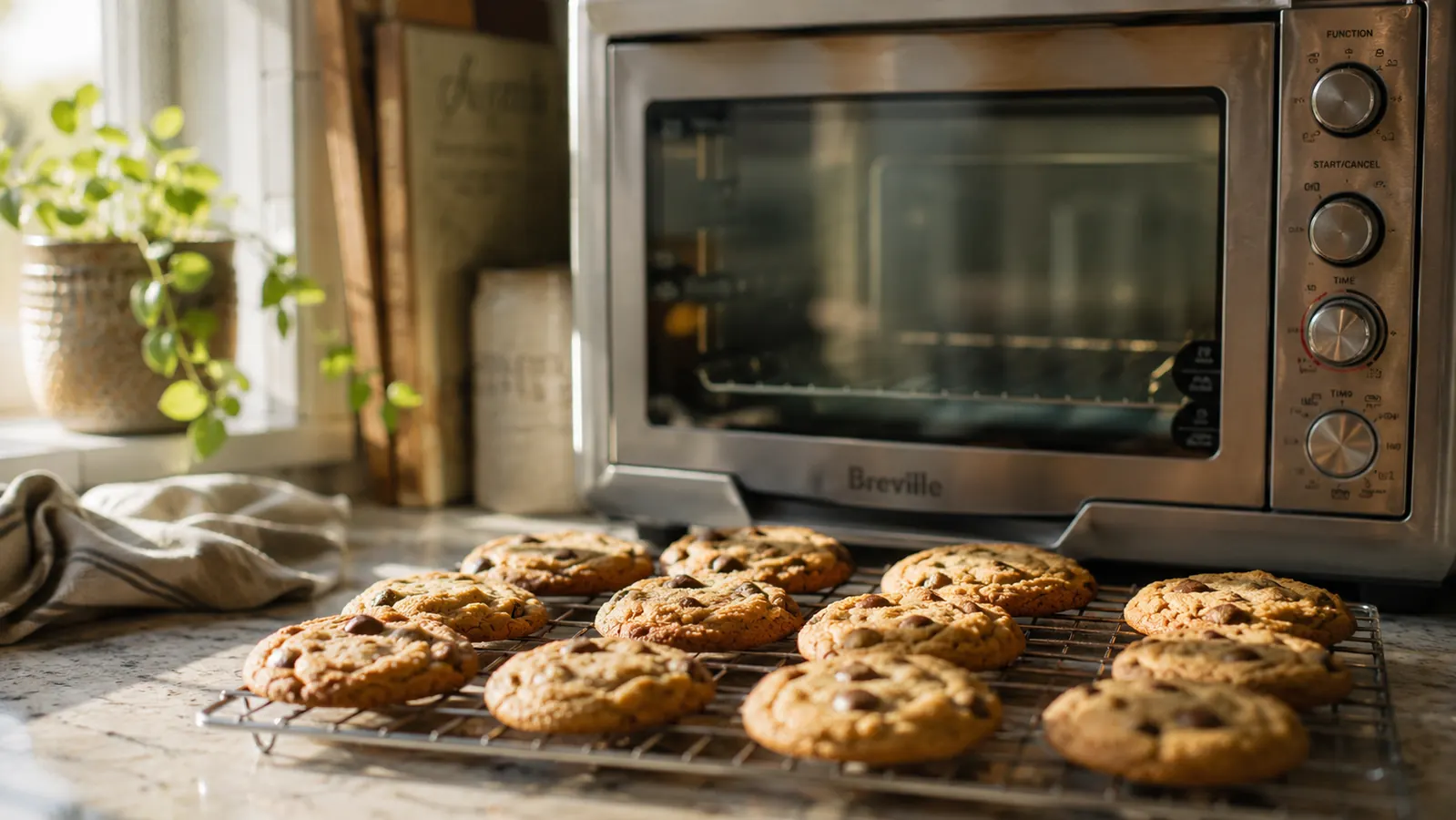
Here is the problem nobody warns you about when you first plug in a convection countertop oven: the recipe you have been using for ten years is wrong for this machine. Not slightly wrong. Burned-on-the-bottom, dried-out-in-the-middle wrong. The first time I baked my standard chocolate chip cookies in the Breville Smart Oven Pro BOV845, I pulled out a pan of flat, over-browned discs and spent twenty minutes blaming myself before I realized the issue was not my recipe. It was that I had not adjusted anything for convection. Once I made three specific changes, the same dough produced the best cookies I had ever baked at home. Crisp edges, chewy centers, completely even color across the whole pan.
Convection moves air. That sounds obvious, but it has real, predictable consequences for cookies specifically. The circulating air strips moisture from the surface faster, which browns the exterior quickly and can set the outside before the center finishes cooking. It also pulls heat from the fan side of the oven more aggressively, so without the right rack position and pan choice, one side of your batch will be done before the other. None of this is a flaw in the Breville. It is physics. Follow these steps and the oven will work with you instead of against you.
Still shopping for a countertop oven that actually bakes well?
The Breville Smart Oven Pro BOV845 has 11,139 reviews and a 4.6-star rating. It holds a full half-sheet pan, holds temperature accurately, and the convection fan is one of the quieter ones I have used. Check the current price on Amazon before you buy elsewhere.
Amazon Check Today's Price on Amazon →Step 1: Drop the Temperature by 25 Degrees
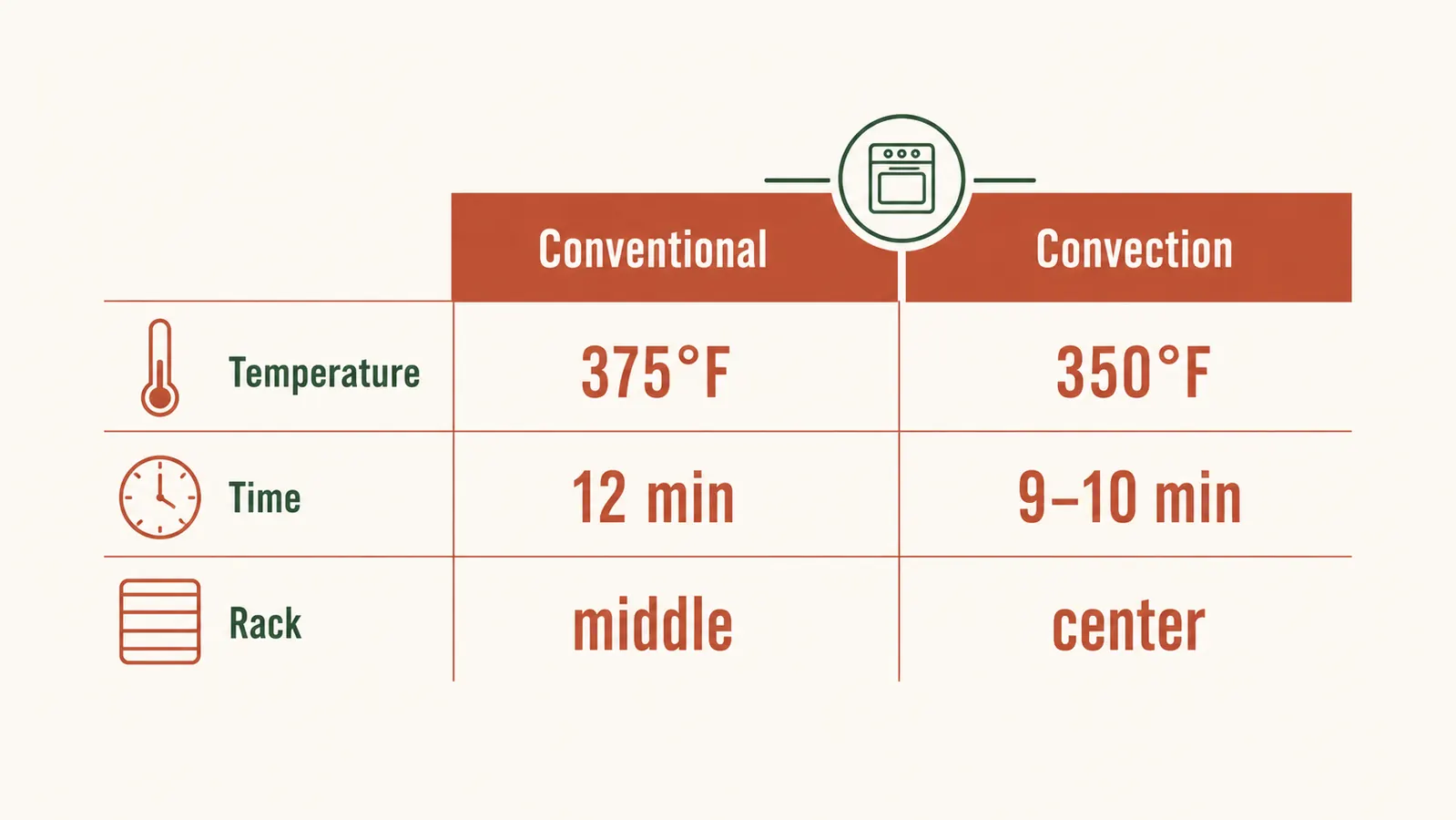
Every convection conversion starts here. If your recipe says 375 degrees Fahrenheit, set the Breville to 350. If it says 350, set it to 325. The moving air transfers heat more efficiently than still air, so the effective temperature inside a convection oven is higher than the dial number suggests. Running at the recipe temperature is the single most common reason people end up with burned bottoms and pale tops in convection mode.
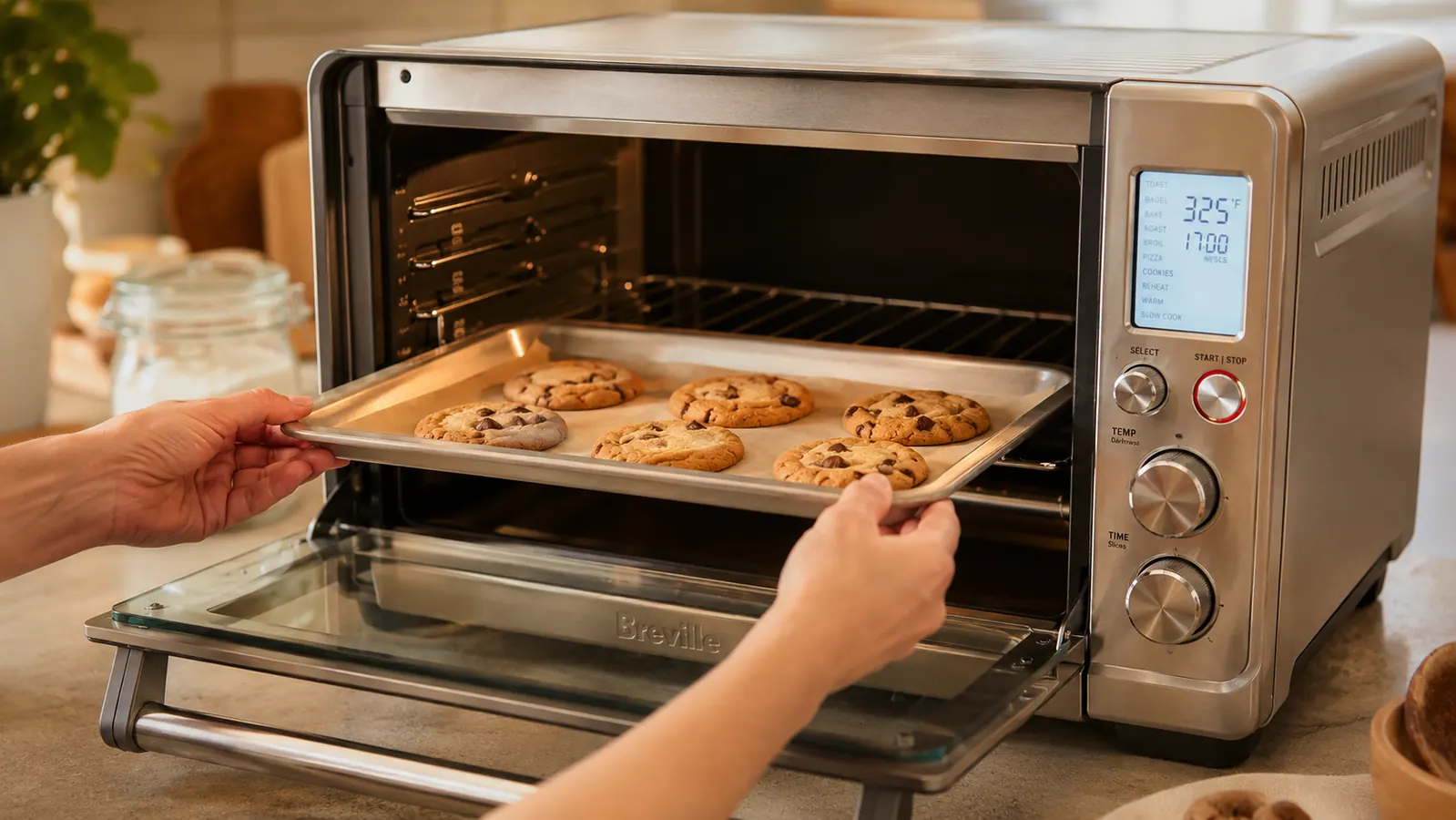
On the BOV845, select the Bake function and then press the Convection button so the fan icon is lit. Set your target temperature. The oven preheats to within a few degrees of accurate and holds it steadily once it is up to temperature, which is more than I can say for most full-size apartment ovens I have used. Give it the full preheat cycle, roughly eight to ten minutes, before the pan goes in. A cold start will throw off every timing estimate in this guide.
One detail worth noting: the BOV845 does not automatically reduce temperature when you switch to convection, the way some newer ovens do. You are setting the actual target, so you need to make the 25-degree reduction yourself every time. I keep a sticky note on the side of my oven: subtract 25, subtract 2 minutes. It sounds excessive but it has saved many batches.
Step 2: Choose the Right Rack Position
The BOV845 has four rack slots. For cookies, use the center slot. Not the second from the bottom, not second from the top. Dead center. The heating elements in this oven are at the top and bottom, and the convection fan is in the back wall. The center slot keeps your cookies equidistant from both heat sources and lets the fan circulate air around the pan rather than blasting it from one direction.
If you try to bake two pans at once in this oven, stop. The interior is not large enough to maintain even airflow around two pans simultaneously. You will get inconsistent browning on both, and the batch will take almost as long as two separate bakes anyway. Bake one pan at a time. In my experience, the Breville bakes a single sheet of a dozen cookies in about nine to ten minutes at 350 degrees, which is fast enough that the back-to-back approach is worth it.
Step 3: Use a Light-Colored, Rimmed Aluminum Pan
Pan choice matters more in convection than in a conventional oven because the moving air accelerates whatever the pan is already doing. A dark pan absorbs more radiant heat and the convection air pushes that heat into the cookie bottoms fast, which is the recipe for burned undersides. A light-colored aluminum half-sheet pan reflects some of that heat and conducts it more evenly. I use a standard commercial-weight aluminum sheet pan and I have never had a burned bottom in the Breville.
Avoid insulated airbake pans in convection mode. The insulated layer that prevents burning in a conventional oven actually blocks heat in convection, which can leave you with underbaked centers even when the tops look done. Also avoid glass or ceramic baking dishes for cookies. They heat unevenly and are hard to read in terms of doneness. Stick with bare aluminum or a light-colored nonstick half-sheet, lined with parchment paper. Parchment helps with release and cleanup without adding any extra insulation.
A dark pan in convection is like pressing the gas and the brake at the same time. You get burned bottoms and underdone centers. Switch to light aluminum and the problem disappears almost immediately.
Step 4: Reduce Bake Time and Start Checking Early
Along with the temperature drop, shorten your bake time by two to three minutes and start checking at the early end. If your recipe says 11 to 13 minutes in a conventional oven, start checking at eight minutes in the Breville on convection. The cookies will look underdone at that point, which is exactly what you want. Carry-over heat from the pan continues cooking them for two to three minutes after they come out of the oven.
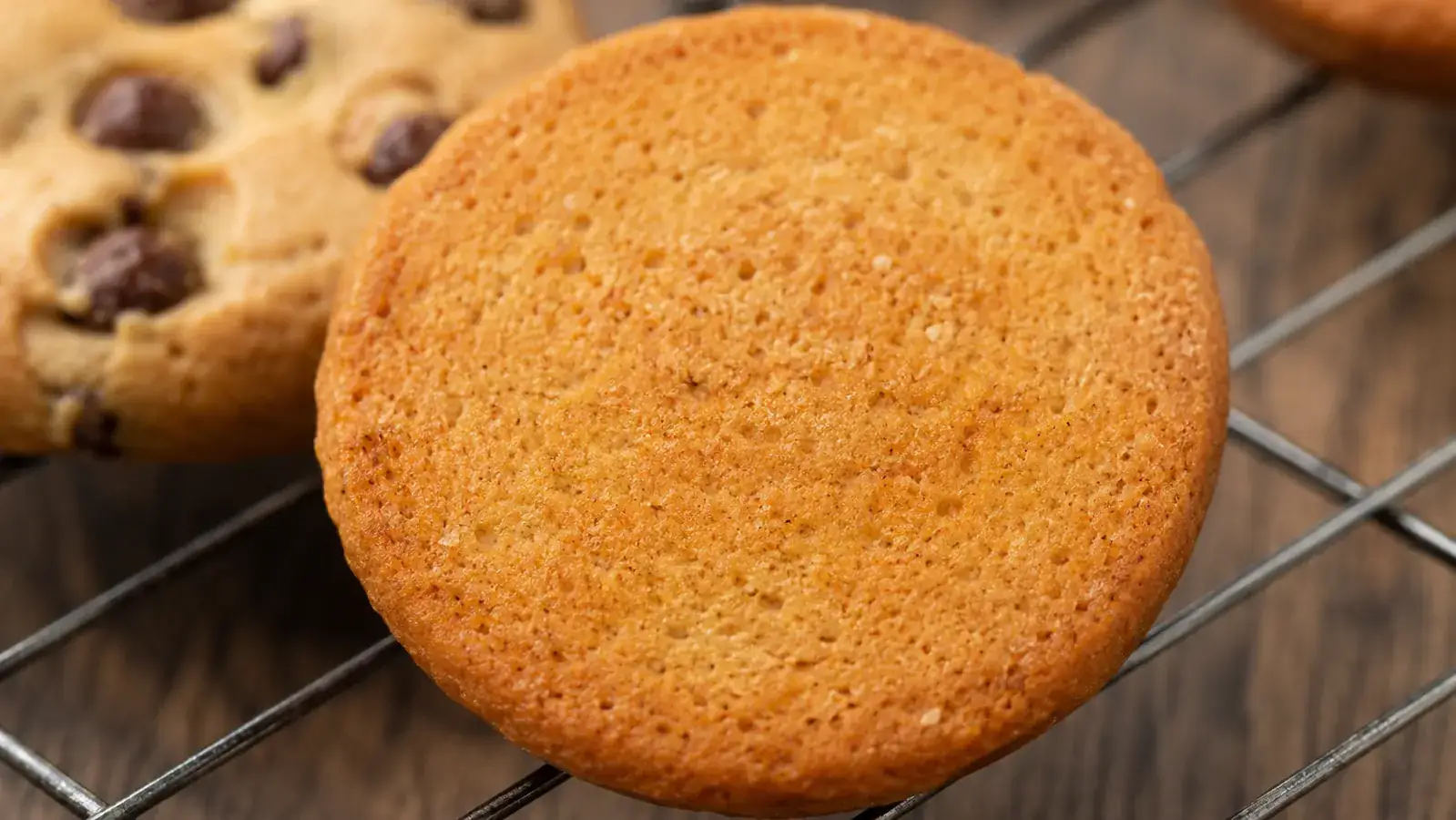
The visual cue I rely on: the edges should be set and lightly golden, and the center should look just barely underdone, almost matte rather than glossy. If you wait until the center looks completely done in the oven, the cookies will be overbaked and dry by the time they cool. Pull them when the edges are firm and the centers still have some give. Let them cool on the pan for five minutes, then transfer to a wire rack. They will continue to set as they cool and the final texture will be exactly what you are aiming for.
The BOV845 has an interior light, which makes it easy to watch the cookies without opening the door. Opening the door mid-bake drops the temperature and disrupts the airflow, which can cause uneven browning in the last few minutes. Get in the habit of using the light instead of peeking.
Step 5: Rotate the Pan Halfway Through If You See Uneven Color
Most of the time in the BOV845, I do not need to rotate. The element distribution and fan placement in this oven are well-calibrated for a countertop unit, and the center rack position takes care of most of the potential for hot spots. But on occasion, particularly with butter-heavy doughs that spread a lot, I will see slightly darker browning on the cookies near the back of the pan, closest to the fan. In that case, rotate the pan 180 degrees at the halfway point of the bake, around the four to five minute mark.
Rotate quickly. Open the door, spin the pan, close the door. The longer the door is open, the more heat you lose. A fast rotation adds about thirty seconds to the total bake time, which you should factor in if you are cutting the time close on your early-check window. After a few batches, you will know whether your specific dough recipe needs rotation or not. I rotate my butter-and-egg-yolk shortbread every time and never rotate my standard Toll House style dough.
What Else Helps
Beyond the five steps, a few details make a consistent difference. First, dough temperature matters more in a fast-baking convection environment. Cold dough straight from the refrigerator spreads more slowly, which means the cookie stays thicker and takes slightly longer to bake through. Room-temperature dough spreads faster and bakes in the shorter time window. Neither is wrong, but once you know which you are working with, you can calibrate your check time accordingly. I keep my dough in the refrigerator and add one minute to my check time as a rule.
Second, cookie size matters. Larger cookies, roughly two tablespoons of dough per cookie, are more forgiving in convection because the ratio of interior mass to surface area is higher. Small cookies, one tablespoon or less, bake extremely fast in convection and the margin between underdone and overdone is narrow. If you are making small cookies, drop the temperature an additional ten degrees and start checking at six minutes. Third, do not skip the preheat. The BOV845 holds temperature well once it is up to temp, but if you put a cold pan into a partially preheated oven, the first few minutes of the bake are unpredictable.
If you want more detail on how the BOV845 performs across different baking tasks beyond cookies, I covered its heating accuracy and element behavior in my full baking review. And if you are still deciding whether a countertop convection oven makes sense for your kitchen, the reasons home bakers switch away from full-size ovens are worth reading before you commit to either direction.
The Breville BOV845 is the countertop oven I actually bake on every week.
Rated 4.6 stars across more than 11,000 reviews. It holds a full half-sheet pan, preheats accurately, and the convection setting is genuinely useful rather than just a marketing feature. If you are tired of your apartment oven guessing at temperature, this is the upgrade that fixes it.
Amazon Check Today's Price on Amazon →